

In a rare display of national unity, legislators from both sides of the aisle worked together this week to pass the most comprehensive effort in decades to bring down the costs of housing and home ownership.
Titled the 21st Century Road to Housing Act, the legislation passed 358–32 in the House and likewise received broad bipartisan support in the Senate. It contains more than 40 separate provisions to make housing more affordable — primarily by easing regulations to expedite construction nationwide.
And perhaps more importantly, the bill would impose first-of-their-kind restrictions to stop predatory investors from buying up large swaths of family properties and limiting the supply available to first-time home buyers.
Progressive Senator Elizabeth Warren called it one of the biggest affordability wins in the past 30 years, promising that it would “bring down costs, and — for the first time ever — stop private equity from buying up single-family homes.”
Nevertheless, one major hurdle still stands between working families and this much-needed relief.
Of course, that would be none other than Donald Trump himself.
Shocking even the members of his own party, the president abruptly cancelled a planned signing ceremony on Wednesday. Rather than taking a victory lap around the bipartisan breakthrough, he decided to hold it hostage at the 11th hour, demanding that Congress vote on his election rigging proposal — the SAVE Act — before he would ever consider signing the housing bill into law.
Reporters recall hearing a shouting match erupt between Trump and Republican legislators sometime after the announcement.
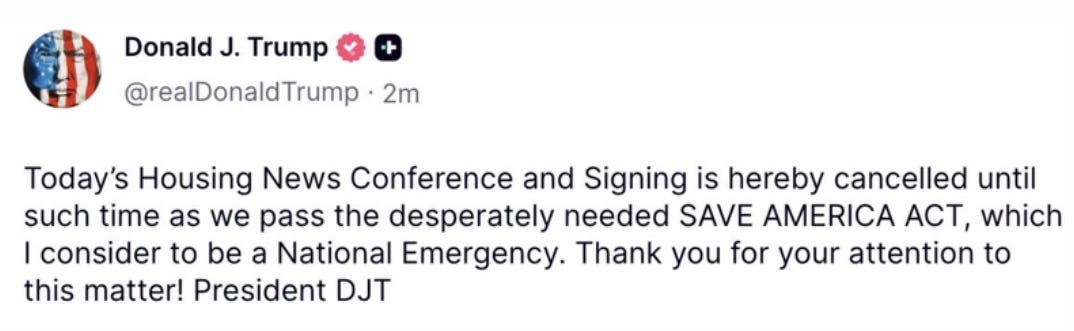
Completely unrelated to housing and affordability, Trump’s proposed Safeguard American Voter Eligibility (SAVE) Act would impose new burdensome restrictions on voting and give the federal government greater control over state elections. Although Republicans insist that the SAVE Act would only require voters to verify their citizenship and eligibility before voting, it specifies that only specific (and expensive) forms of photo ID would be accepted.
To be allowed to vote under the proposal, citizens would need to produce a valid passport (costing more than $100 and involving a multi-month process) or track down a birth certificate matching their current name. The latter would be especially difficult for married women who have taken their husband’s surname, presumably making a passport their only viable option.
Therefore, experts and critics are calling the SAVE Act a poll tax — an unconstitutional and completely anti-American tax on democracy itself. If passed, tens of millions of legal citizens would be deprived of their fundamental right to participate in elections, unless they’re willing to pay the government a steep fee and play the waiting game with the post office.
Moreover, the SAVE Act would enact additional prohibitions on mail-in voting and force states to regularly purge their voter rolls. Make no mistake, this would be an unprecedented power grab, giving Trump the authority to challenge or overturn any election he and his sycophants don’t win.
It has nothing to do with election security or common sense — it’s all about suppressing democracy . After all, Republicans only win when turnout is low, and disenfranchising tens of millions would certainly help make that happen.
Through all of this, Trump has frustratingly continued to downplay affordability concerns as reporters question him about his refusal to sign the landmark housing bill, going on to rant about the threat posed by “communists.”
Thankfully, the SAVE Act has no pathway to becoming law as Senate Democrats remain united in their opposition to Republican election rigging. Additionally, if Trump refuses to sign Congress’s housing bill — but does not directly veto it — that legislation will automatically become law after a 10-day window.
However, if Congress adjourns and doesn’t return by the end of the window, the bill could still die through what is known as a “pocket veto.” While this occurrence is somewhat rare, Congress is not expected to be in session on July 4 because of America’s 250th anniversary, so there might be a chance Trump tries to exercise this option if he doesn’t veto it outright.
Currently, the Fourth of July break is only expected to be a brief recess, not a full adjournment, which would reportedly not be enough to trigger a pocket veto. Unless there is a change plans, the president will likely have to make a definite decision before the holiday break.
In any case, Congress would theoretically have the votes to override the president, but Republicans have shown great reluctance to directly challenge the him on any substantive matters of importance. At the end of the day, his sycophants always fall in line, regardless of how it impacts their constituents.
Now that Trump has made his position clear, they have no other option but to parrot his demented narrative, while hoping he eventually changes his mind. If Congress is forced to vote on the bill a second time, it surely won’t see the same level of bipartisan support as it did this week.
While Republican House Speaker Mike Johnson reaffirmed his belief that Trump would come around to signing the bill, he — as spineless as ever — didn’t offer any kind of pushback.
Regardless of whether Trump changes his mind over the next 10 days, holding up such a vital piece of legislation for any reason and any length of time is an unforgivable attack on the millions of working families across America who are fighting to keep a roof over their heads.
With prices surging on everything from rent to groceries, this is not the moment for political gamesmanship.
Of course, nobody should be surprised by this deplorable behavior, as Trump in recent months has repeatedly claimed that the entire concept of “affordability” doesn’t exist, going so far as to allege that Democrats made up the word. Earlier this month, he even said he ‘loves’ the inflation caused by his war against Iran.
This is another pressing reminder of why it’s so important to kick Republicans out of office at the end of the year. Even in the rare moments of conscience where the entirety of Congress decides to do something good for the American people, the president’s henchmen never have the courage to stand up to his demented leadership whenever he stands in the way.
Needless to say, a Democratic supermajority won’t have that problem.
We’re fighting MAGA and electing Democrats in all 50 states. To help support the next generation of progressive leaders, please consider joining our movement as a free or paying subscriber.